Monday, 4 April 2016

Rate of Change Continuum

A continuum is something where the level difficulty increases in incremental steps. In this case the continuum is dealing with calculating the rate of change (slope) of a linear relationship.
We have previously posted a continuum for solving equations here and here but this one is a bit different. This one has five levels of determining the rate of change from a graph (in context) for a linear relationship. The first level shows lattice points, a rate triangle and the calculation of both rise and run (super basic) and the difficulty increases with each level (see below) until the last level where there is only a scale with no grid lines (so the answer is more of an estimate).
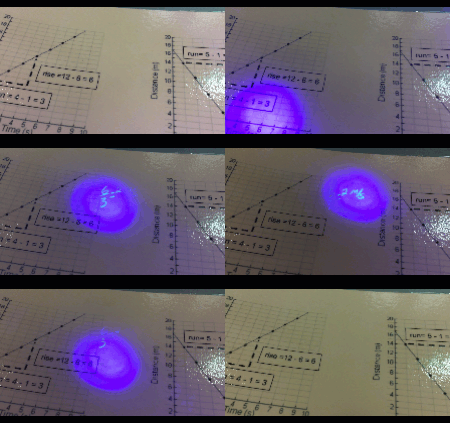
Each page has 6 graphs and students (once they choose the level to start with) choose to answer any three. If they do so correctly then they can move to the next level. The To make things a bit more fun, rather than check the answers with you, we suggest using a UV pen and ink written on the question cards for students to check.
This activity is probably best meant as a consolidation. Note that the expectation is about investigating so hopefully students will have had a chance to develop their own strategies for determining the rate of change. This activity just helps to scaffold it a bit in case they are having trouble (Eg a common mistake that students make when determining the rate of change when the line is in context is to just count boxes for the rise and run without considering the scale).
Note that we also have an Explain Everything version if you have students who have iPads (you may even want to try out the new Explain Everything Collaborative Whiteboard app to have students work in groups from different devices).

  • MPM1D, MFM1P - determine, through investigation, connections among the representations of a constant rate of change of a linear relation.
  • 20 copies of each of the question cards in different colour cardstock for each level,  laminated (use colours that allow seeing the magic pen writing). Note that you may not need 20 copies of each. Perhaps fewer of the first couple levels and last level as most kids will probably be starting in the 2nd or 3rd level
  • 3 sets of the answer cards (use magic pen to write the answers anywhere along each equation, they could be sideways, upside-down, (the answers are on the last page of the Google Doc). To help distinguish the answer cards to the question cards you should put a stamp or sticker on the back.
  • 3 "magic" pens can be purchased at Chapters/Indigo or we found these at a Scholastic's book fair. We have since purchased some on eBay.

  1. For this activity to be successful, students must start at the appropriate envelope. If they start in one that is too hard they will be frustrated and if they start in one that is too easy they will be bored. Use an exit card (the day before) to help you decide which envelope each student should start in. When given back the exit card write down the level they will start in. 
  2. Place the questions in piles in order of difficulty and set up three stations for the answer cards. Students will get a card and answer any 3 questions. 
  3. To check their answers, they will go to a station and use the magic pens. Students may decide to do one question at a time and then go check their answer or they may do all 3 and then check. Students are monitoring themselves so they decide. If they get the first 3 right, they have a level of mastery to move themselves to the next level. If not there are more questions on the card until they master that type. 
  4. As they move through the continuum, the hope is that they reach level 4 which matches the grade 9 curriculum. Since our goal is to get them to level 4, students should solve ALL equations on that card instead of just three. 
  5. The fifth level is set up to challenge students who are moving forward quickly. They should solve all questions on this card. They require some estimation and so answers that students get should be approximate. 
Note that for the Explain Everything version, there are still 6 possible graphs for each level but only two on each page. And to check the answer, slide the black ellipse to either the bottom left or right corner. 
Did you use this activity? Do you have a way to make it better? If so tell us in the comment section. Thanks

Sunday, 28 February 2016

Geometer's Sketchpad - Trig Ratio Generator

When using the Geometer's Sketchpad (for both computer and iPad) it is often better to "start from sketch, not from scratch". That is, give students a premade sketch rather having them build something from nothing (as many textbooks would have you do).
In this activity, students can practice two very specific skills dealing with trigonometry. The first is simply being able to correctly place the names of the sides of a right triangle (opposite, adjacent and hypotenuse). Students drag the side names and then can check their answers and then randomly generate another triangle to try again. The second is one where a random triangle is generated that shows information about two sides and one angle. Students then drag parts of an equation to create a trig ratio equation. They can check their answer and then randomly generate other right angled triangle to try again. 
This is not meant to be something that a student uses for a long length of time but instead just some quick practice to re enforce the basic ideas from trig ratios.
  • MFM2P, MPM2D - determine, through investigation (e.g., using dynamic geometry software, concrete materials), the relationship between the ratio of two sides in a right triangle and the ratio of the two corresponding sides in a similar right triangle, and define the sine, cosine, and tangent ratios.
  • MCR3U, MCF3M, MBF3C - As review
  • All that is needed is the electronic download (below)
  • Note that this really works well on an iPad using the Sketchpad Explorer App (which is free)
  • You can also use this on any web based computer (or Chromebook) with this Web sketch
Watch the video below to see how to use the sketch


Did you use this activity? Do you have a way to make it better? If so tell us in the comment section. Thanks

Friday, 19 February 2016

Number Sentences Sort (update)

One of the smaller expectations we have to deal with is the ability for students to interpret algebraic equations. You know: "what does 2x + 1 mean"?. We created this very simple sorting activity where students are given expressions (and equations) and the sentence to describe them and have to match them up. This is meant to be an activity that is relatively quick. We have two versions here. One for grade 7 that only has expressions and one for grade 8 that has equations as well. We also have an Explain Everything version of each so that if you have an iPad (or Chromebook), with that app, you can have your students sort them electronically. This can also be used as review in Grade 9.
Note: This is an update to the same activity posted last year but now with a grade 8 and Explain Everything version
Double Note: This has been updated again to now include a Desmos card sort. So both card sorts are now transferred to this new Desmos feature. You can learn about Desmos Card Sorts by clicking here. Download the Teacher versions (which you can copy) of these activities below in the download section.
  • Gr7PA - translate phrases describing simple mathematical relationships into algebraic expressions using concrete materials
  • Gr8PA - translate statements describing mathematical relationships into algebraic expressions and equations
  • MPM1D, MFM1P - As review
  • For the grade 7 version there are four different (but similar) sets. One set per page. For the grade 8 version there are three different (but similar) sets. One set per page. 
  • Print each page on card stock (we also suggest laminating). We suggest that each set be printed on different colour card stock for easy sorting. Cut each out and put each set in an envelope.
  • Obviously you will have to decide how many sets you will need for your class depending on whether you pair students up or not. 
  • Note that in the version with equations, there are some algebraic expressions that do not have matching sentences. In these cases, students will have to write their own.
  • If you choose to use the Explain Everything version, then you probably want to download that .xpl file and put it on a server where your students can get easy access to it. 
Explain Everything Screenshot
  1. Depending on how many students you have you may want to do this individually, in pairs or in larger groups. The activity is not super complex so we don't recommend anything bigger than pairs. 
  2. Students take each set and sort the algebraic expression with the written version. 
  3. When they are done their set they can trade with another group that has a different colour of cards. If they are using the Explain Everything version then they can just go to the next slide. 
  4. There is a homework sheet for consolidation that includes both expressions and equations as well.
Did you use this activity? Do you have a way to make it better? If so tell us in the comment section. Thanks

Saturday, 30 January 2016

Row Games

We saw this activity in 2010 when I first found @K8Nowak's blog f(t). I don't know if I would call a Row Game a particularly engaging activity but I am convinced that any way we can make doing boring homework questions more palatable for students is a good thing. The premiss is that you pair students up and they get a worksheet of questions. The questions are in two columns. Each person does one column and if they have done things correctly then their questions on the same row should have the same answer. If they don't then either one or both of them are incorrect and they have to work together to get the correct answer. So this is a self checking activity. We made a bunch of them at the time and I just stumbled upon them this week so we thought we would post them. These ones are for ratios, proportion, simplifying expressions and solving simple equations.

MFM1P, MPM1D
  • illustrate equivalent ratios, using a variety of tools
  • solve for the unknown value in a proportion, using a variety of methods 
  • make comparisons using unit rates
  • solve problems involving ratios, rates, and directly proportional relationships in various contexts, using a variety of methods
  • solve problems requiring the expression of percents, fractions, and decimals in their equivalent forms
  • add and subtract polynomials involving the same variable up to degree three, using a variety of tools
  • multiply a polynomial by a monomial involving the same variable to give results up to degree three
  • solve first-degree equations with non fractional (Applied only) coefficients, using a variety of tools and strategies
  •  Just the handouts (see below)
  1. Pair students up
  2. Have students decide who will be Student A or Student B, and have them complete Problem Set A or B.
  3. The answers in each row should match. If they do not match, work together to determine the correct answer.
  • See the files in one folder here
  • Proportions (Word, PDF)
  • Proportions Review (Word, PDF)
  • Simplifying Expressions (Word, PDF)
  • Adding Polynomials (Word, PDF)
  • Simplifying Expressions with Multiplication (Word, PDF)
  • Solving Equations (Word, PDF)
  • Solving Multistep Equations (Word, PDF)
Did you use this activity? Do you have a way to make it better? If so tell us in the comment section. Thanks

Monday, 25 January 2016

Grade 11 Exam Review Tower Challenge

This is a review activity on many of the topics found in grade 11 university where students answer questions and are rewarded with building materials for each correct answer. The building materials (spaghetti & marshmallows) are then used with the goal being the creation of tallest tower. This is based originally on a TIPS activity on quadratics for MBF3C (Unit 3, Day 6).  

MCR3U 
  • demonstrate an understanding of functions, their representations, and their inverses, and make connections between the algebraic and graphical representations of functions using transformations;
  • determine the zeros and the maximum or minimum of a quadratic function, and solve problems involving quadratic functions, including problems arising from real-world applications;
  • demonstrate an understanding of equivalence as it relates to simplifying polynomial, radical, and rational expressions.
  • evaluate powers with rational exponents, simplify expressions containing exponents, and describe properties of exponential functions represented in a variety of ways;
  • identify and represent exponential functions, and solve problems involving exponential functions, including problems arising from real-world applications.
  • demonstrate an understanding of the relationships involved in arithmetic and geometric sequences and series, and solve related problems;
  • make connections between sequences, series, and financial applications, and solve problems involving compound interest and ordinary annuities.
  • determine the values of the trigonometric ratios for angles less than 360º; prove simple trigonometric identities; and solve problems using the primary trigonometric ratios, the sine law, and the cosine law;
  • demonstrate an understanding of periodic relationships and sinusoidal functions, and make connections between the numeric, graphical, and algebraic representations of sinusoidal functions;
  • identify and represent sinusoidal functions, and solve problems involving sinusoidal functions, including problems arising from real-world applications.
  • 1 bag of spaghetti and 1-2 bags of small marshmallows (or 1 box of straws and 1-inch pieces of tape)  
  • a question sheet for each student
  • a teacher answer sheet 
  • Optional - a whiteboard for each student to work out their solutions
  • Optional - prize for the group with the tallest tower
  1. Place students in groups (ideally no bigger than 3 per group)
  2. Hand out question sheets (and optional whiteboards) to each student.
  3. Have students answer questions from their sheet in any order they want. For every correct answer they will get some building materials (eg: 2 spagetti & 3 marshmallows, the amount of each reward is indicated on the student question sheet ). The harder the question the more materials they will get. Eventually the building materials will be used to create a tower with the goal to create the tallest free standing tower.
  4. Students work in groups to answer the questions and bring their solutions up to you to be checked. Only one member from each group can come up at a time. Each group can answer each question only once. To keep track of this, use the teacher answer sheet to check off which questions each group has answered as they come up.
  5. Leave about 20 min at the end of the class for students to create their towers (students can no longer answer questions)
  6. Take lots of pictures and celebrate the group with the tallest free standing tower.
  • Gr11UTowerChallengeExamReview (with answer sheet) (pdfdoc)
Did you use this activity? Do you have a way to make it better? If so tell us in the comment section. Thanks

Monday, 21 December 2015

Simplifying Expressions and Solving Equations Tower Challenge

This is a review activity on simplifying expressions and solving equations for grade 9 applied where students answer questions and are rewarded with building materials for each correct answer. The building materials (spagetti & marshmallows) are then used with the goal being the creation of tallest tower. This is based originally on a TIPS activity on quadratics for MBF3C (Unit 3, Day 6).  We have a similar activity for grade 9 academic that can be found here.

MPM 1P
  • substitute into and evaluate algebraic expressions involving exponents 
  • describe the relationship between the algebraic and geometric representations of a single-variable term up to degree three [i.e., length, which is one dimensional, can be represented by x; area, which is two dimensional, can be represented by (x)(x) or x2; volume, which is three dimensional,can be represented by (x)(x)(x), (x2)(x),or x3]
  • add and subtract polynomials involving the same variable up to degree three using a variety of tools
  • multiply a polynomial by a monomial involving the same variable to give results up to degree three using a variety of tools
  • solve first-degree equations with nonfractional coefficients, using a variety of tools
  • substitute into algebraic equations and solve for one variable in the first degree
  • 1 bag of spaghetti and 1-2 bags of small marshmallows (or 1 box of straws and 1-inch pieces of tape)  
  • a question sheet for each student
  • a teacher answer sheet 
  • Optional - a whiteboard for each student to work out their solutions
  • Optional - prize for the group with the tallest tower

  1. Place students in groups (ideally no bigger than 3 per group)
  2. Hand out question sheets (and optional whiteboards) to each student.
  3. Have students answer questions from their sheet in any order they want. For every correct answer they will get some building materials (eg: 2 spagetti & 3 marshmallows, the amount of each reward is indicated on the student question sheet ). The harder the question the more materials they will get. Eventually the building materials will be used to create a tower with the goal to create the tallest free standing tower.
  4. Students work in groups to answer the questions and bring their solutions up to you to be checked. Only one member from each group can come up at a time. Each group can answer each question only once. To keep track of this, use the teacher answer sheet to check off which questions each group has answered as they come up.
  5. Leave about 20 min at the end of the class for students to create their towers (students can no longer answer questions)
  6. Take lots of pictures and celebrate the group with the tallest free standing tower.


  • Gr9AppliedSimplifyingExpression&SolvingEquationsTowerChallengeQuestions (pdfdoc)
  • Gr9AppliedSimplifyingExpression&SolvingEquationTowerChallengeTeacherAnswerSsheet (pdfdoc)
Did you use this activity? Do you have a way to make it better? If so tell us in the comment section. Thanks