Showing posts with label Geometry. Show all posts

Monday, 14 December 2015

I Have, Who Has - Angles

An I Have, Who Has game is not a new concept. The premiss is that each person gets a card that has two statements. One is the "I have" statement and the other is the "Who has" statement. In this case the "I have" statement is an diagram dealing with determining an angle and a "Who has" statement which is the angle. The way the game works is that a person starts by reading their "Who has" statement. For example, someone might say "Who has 138o?". Someone else will have a card where their diagram has an angle that equals 138o so they would say " I have x = 138o". Who has 136o?" That is, they read their angle that equals 138o and then asks their "Who has" statement. Then someone else will have an expression that matches 136o and the game continues. If done correctly, it should end up with the person who started giving their "I have" statement. It works really well as a warm up and one of nice things about this is that you could do it multiple days and kids will likely get different cards.
In this set there are questions for parallel lines with a transversal, complimentary angles, supplementary angles, exterior angles, sum of interior angles and opposite angles questions

  • Gr8GSS - solve angle-relationship problems involving triangles (e.g., finding interior angles
    or complementary angles), intersecting lines (e.g., finding supplementary angles or opposite angles), and parallel lines and transversals (e.g., finding alternate angles or corresponding angles) NOTE - only use the 9 card set if doing this for grade 8;
  • MPM1D - determine, through investigation using a variety of tools (e.g., dynamic geometry software, paper folding), and describe some properties of polygons, and apply the results in problem solving
  • MPM1D, MFM1P - determine, through investigation using a variety of tools (e.g., dynamic geometry software, concrete materials), and describe the properties and relationships of the interior and exterior angles of triangles, quadrilaterals, and other polygons, and apply the results to problems involving the angles of polygons
  • MFM1P - determine, through investigation using a variety of tools (e.g., dynamic geometry software, concrete materials), and describe the properties and relationships of the angles formed by parallel lines cut by a transversal, and apply the results to problems involving parallel lines
  • There are two sets of cards that you could download here. One set (pictured here) has only 9 cards in it (you can see that the card on the top left has the "I have" to match the "Who has" of the card on the bottom right). Depending on the size of class you have you might want to use this set multiple times (ie groups of 9) or use the larger set of 27. Either way, in order for the game to work, all cards need to be passed out. So some students may need to have more than one card.
  • Regardless. Print out the set you want (ideally on coloured card stock) and we also suggest lamination to lengthen the lifespan of the cards.
  • Be sure to print out a set for yourself that you don't cut out so that it will be easier for you to check as students play the game.
  1. Distribute the cards one per student. All cards must be handed out so some students might need more than one card.
  2. Tell each person to determine the indicated angle in their "I have" diagram and check their answer with at least one other person. 
  3. Once students are confident with their answer all students should stand and then you choose one to read their "Who has" statement. The person who's answer is the same should read their "I have" statement followed by their "Who has" statement and then sit down. Eventually the last person standing should be the person who started. 
  4. A variation might be to have students walk to the front and stand next to the person who they were matched with and eventually form an entire loop around the class.
  • IHaveWhoHas-Angles-9cards (pdf) (doc)
  • IHaveWhoHas-Angles-27cards (pdf) (doc)
  • IHaveWhoHas-BlankTemplate (doc)
Did you use this activity? Do you have a way to make it better? If so tell us in the comment section. Thanks

Thursday, 8 January 2015

Geometry Board Game


This is a geometry review activity where students will find missing angles formed by lines, in triangles and in polygons. The game is loosely based on the Candyland board game where students move pieces around a board and answer questions based on the colour they land on.


  • MPM1D, MFM1P - determine, through investigation using a variety of tools (e.g., dynamic geometry software, concrete materials), and describe the properties and relationships of the interior and exterior angles of triangles, quadrilaterals, and other polygons, and apply the results to problems involving the angles of polygons
  • MFM1P - determine, through investigation using a variety of tools (e.g., dynamic geometry software, concrete materials), and describe the properties and relationships of the angles formed by parallel lines cut by a transversal, and apply the results to problems involving parallel lines

For each group (groups of two or four - playing against each other or in teams of two)

  • up to four game pieces 
  • one die
  • one game board printed in colour on card stock (laminated if possible). If you wish, one group can play on the Smartboard.
  • one instruction sheet printed on card stock (laminated if possible) with answer sheet on the back (preferably printed in colour)
  • one set of question cards. Each set consists of five types of questions that are colour coded. Print each on colour card stock (there is one page with 8-10 questions for each colour) and laminate (if possible) then cut them out. The colour of the cards loosely group the types of questions to supplementary, complementary, opposite angles (yellow), angles in triangles (blue), parallel lines (red), angles in polygons (green), more challenging questions that may require algebra (white). 

Game Setup
  1. Separate the cards by colour. Shuffle each colour and make a face down pile for each.
  2. Decide on teams (or play individually) and place a marker on START for your team.
  3. Keep the answer card face down at all times until checking your answers. 
Game Play
  1. Each team takes turns rolling the die and moving your markers.
  2. When you land on a colour, choose the appropriate card and answer the question (determine the values of the unknown variables). You have up to 2 minutes to answer your question.
  3. A player from the opposing team uses the answer key to quickly check your answer. If you do not answer your question correctly, move back to your last position.  Remember: the answer sheet must remain face down at all times except for checking solutions.
  4. If you land on a Mystery spot (marked with a ?) you will have 3 minutes to answer (since these are tougher questions). If you answer correctly, you get a free die roll and move to the appropriate spot without having to answer another question. If you answer incorrectly move back to your last position as before.
Ending the game
  1. To win the game, you must land exactly on the “You Win!” spot.
  2. Once there, the opposing team will choose a question (but not a Mystery question) from one of the piles (without looking).
  3. If you answer correctly, you win. If you answer incorrectly, move back to your last spot. 

The video, below, is only visible in the WECDSB domain. That is, only teachers in our school board can see the video if they are logged into their MyTools2Go accounts.


Did you use this activity? Do you have a way to make it better? If so tell us in the comment section. Thanks


Friday, 19 December 2014

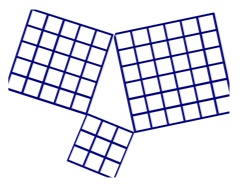
The Area Representation of Pythagorean Theorem

In Grade 8 here in Ontario, Pythagorean Theorem is introduced for the first time. It is pretty common for students to only see a2 + b2 = c2 and they move on. This can be a problem for students since if they only see that formula, they can't get past the a's, b's & c's and often get them mixed up because they don't understand them (so many kids can recite a2 + b2 = c2 proudly but that's where their expertise stops). But if you examine the expectations, you will see that really the focus is on the conceptual nature of the relationship. So we developed this activity to focus on the area representation of PT. The premiss is that students are given six sets of three numbers. The numbers come in the form of the side lengths of squares. Three of the sets are Pythagorean Triples the others are not (students are not told this). They then use the given squares to construct triangles (using the squares as the side lengths) and (hopefully) discover that right angled triangles have a special relationship with the areas of the squares.
A NEW ADDITION is an Explain Everything version. In this version students manipulate the squares right in the app.

  • Gr8NS1.4 - determine the Pythagorean relationship, through investigation using a variety of tools (e.g., dynamic geometry software; paper and scissors; geoboard) and strategies; 
  • MPM1D, MFM1P - relate the geometric representation of the Pythagorean theorem and the algebraic representation a2 + b2 = c2 ;
  • Print (on card stock preferably), laminate (optional) and cut out the squares. Note that the squares should be cut out as tightly to the edge as possible. Each group of 6 should have one set of cards. 
  • Each group should have 1-2 pieces of chart paper
  • Markers 
  • whiteboards (optional)

  1. Place students in groups of six (or in any group size that could be split in two).  Three students will construct triangles using squares with the following side lengths:     1) 5, 10, 12     2)  9, 10, 17   3) 12, 13, 15  (this group will create non right angled triangles - don't tell them this). The other three students will construct triangles using squares with side lengths:  4) 5, 12, 13   5) 6, 8, 10      6) 8, 15, 17 (this group will create right angled triangles - don't tell them this). Regardless, each set of students should trace the triangles and the squares that form them on their own chart paper (if they don't trace them, they won't have enough squares).
  2. Ask the group of six if they notice anything different between triangles in groups 1, 2, 3 compared to groups 4, 5, 6 (hopefully they they will notice that in one set the triangles are right)
  3. Ask students to find the area of each square and see if they can find any relationship in the squares in each of groups 4, 5 & 6 compared to groups 1, 2 & 3 ( you may need to steer some groups towards the sum of the areas with gentile questioning)
  4. Discuss, as a group, what they discovered.
  5. Give students a whiteboard and ask them to find the missing sides in triangles. A Smartboard file is attached with several more triangles.
  6. As an extension students can investigate how general the area relationship is using this WebSketch.
Note: if using the Explain Everything version, all six groups are on the same file. So depending on how many iPads you have, you may group students differently. 


  • Square Templates (pdf) (doc)
  • Explain Everything (xpl)
  • Pythagorean Relationship practice (not) (pdf
  • Geometer's Sketchpad Area Relationship (WebSketch) (GSP file)
Did you use this activity? Do you have a way to make it better? If so tell us in the comment section. Thanks