Showing posts with label review activity. Show all posts

Thursday, 20 April 2017

Fraction Operation Continuum

As math teachers we definitely want our students to practice to become proficient but piles of problems or worksheets aren't going to be very engaging to students. We think this tweak to the standard worksheet is a way to turn those boring questions into something more engaging.

In Ontario, grade 7s are introduced to operations with fractions. Addition & subtraction and multiplication & division with whole numbers. The premiss here is fairly simple. Students are presented with multiple cards of questions (in this case of adding and subtraction of fractions (with a little of division and multiplication with whole numbers). The cards represent problems that increase in difficulty as you go from one to the next. Students can all start at the first envelope or you could give them an exit card the day before to help place them in a particular card to start. Students check their own answers using answer cards with the answers written with "invisible" ink that can be revealed by shining a UV light on it.

Students really seem to like this style of activity as they feel empowered to move from card to card when they are ready and the added feature of checking the answers with the UV pen gives a sense of novelty. This could be used as practice or review.

  • Gr7 - divide whole numbers by simple fractions
  • Gr7 - use a variety of mental strategies to solve problems involving the addition and subtraction of fractions
  • Gr7 - add and subtract fractions with simple like and unlike denominators, using a variety of tools (e.g., fraction circles, Cuisenaire rods, drawings, calculators) and algorithms;
  • Gr7 -  demonstrate, using concrete materials, the relationship between the repeated addition of fractions and the multiplication of that fraction by a whole number
  • Gr8 - As review (we plan an extension so that this could be used for grade 8 with multiplying and dividing fractions)
  • Enough copies of each of the question cards for your class (there are four cards per page at each level) in different colour card stock for each level,  laminated (use colours that allow seeing the magic pen writing - you may want to test this). You will likely not need as many cards in the last few envelopes as students work at different paces. You will need as many as you have in your class if you decide to start everyone at the first level. Fewer if you let students start at different levels (see below)
  • 3 sets of the answer cards (use magic pen to write the answers anywhere along each equation, they could be sideways, upside-down, (the answers are on the last page of the Google Doc). The answer cards are the same as the question cards but you write the answers in invisible ink on them. To help distinguish the answer cards to the question cards you should put a stamp or sticker on the back. Write on the cards first then laminate them. If you write on the card after lamination then the ink tends to wear off. There is a separate answer card on the last page of the download. That is for you to carry around (or not) but not for showing students but more for your reference.
  • 3 "magic" pens can be purchased at Chapters/Indigo or we found these at a Scholastic's book fair. We have since purchased some on eBay or Amazon.

  1. Place the questions in piles (or in envelopes taped to the wall) in order of difficulty and set up three stations for the answer cards. Students will get a card and answer the first 5 questions. 
  2. You could have all students start at level 1 but for this activity to be most successful, students should start at the appropriate envelope. If they start in one that is too hard they will be frustrated and if they start in one that is too easy they will be bored. Use an exit card (the day before) to help you decide which envelope each student should start in. When given back the exit card write down the level they will start in. 
  3. To check their answers, they will go to a station and use the magic pens. Students may decide to do one question at a time and then go check their answer or they may do all 5 and then check. Students are monitoring themselves so they decide. If they get the first 5 right, they have a level of mastery to move themselves to the next card. If not there are more questions on the card until they master that type. You can decide whether you want them to do the other 5 or just do enough to get a total of five correct. 
  4. As they move through the continuum, the hope is that they reach level 6 which matches the grade 7 curriculum. Since our goal is to get them to level 6, students should solve ALL equations on that card instead of just five. 
  5. The seventh level is set up to challenge students who are moving forward quickly. They should solve all questions on this card.  


  • Fraction Operation Continuum (with Answers) - (PDF, Google Doc)
Did you use this activity? Do you have a way to make it better? If so tell us in the comment section. Thanks

Monday, 25 January 2016

Grade 11 Exam Review Tower Challenge

This is a review activity on many of the topics found in grade 11 university where students answer questions and are rewarded with building materials for each correct answer. The building materials (spaghetti & marshmallows) are then used with the goal being the creation of tallest tower. This is based originally on a TIPS activity on quadratics for MBF3C (Unit 3, Day 6).  

MCR3U 
  • demonstrate an understanding of functions, their representations, and their inverses, and make connections between the algebraic and graphical representations of functions using transformations;
  • determine the zeros and the maximum or minimum of a quadratic function, and solve problems involving quadratic functions, including problems arising from real-world applications;
  • demonstrate an understanding of equivalence as it relates to simplifying polynomial, radical, and rational expressions.
  • evaluate powers with rational exponents, simplify expressions containing exponents, and describe properties of exponential functions represented in a variety of ways;
  • identify and represent exponential functions, and solve problems involving exponential functions, including problems arising from real-world applications.
  • demonstrate an understanding of the relationships involved in arithmetic and geometric sequences and series, and solve related problems;
  • make connections between sequences, series, and financial applications, and solve problems involving compound interest and ordinary annuities.
  • determine the values of the trigonometric ratios for angles less than 360ยบ; prove simple trigonometric identities; and solve problems using the primary trigonometric ratios, the sine law, and the cosine law;
  • demonstrate an understanding of periodic relationships and sinusoidal functions, and make connections between the numeric, graphical, and algebraic representations of sinusoidal functions;
  • identify and represent sinusoidal functions, and solve problems involving sinusoidal functions, including problems arising from real-world applications.
  • 1 bag of spaghetti and 1-2 bags of small marshmallows (or 1 box of straws and 1-inch pieces of tape)  
  • a question sheet for each student
  • a teacher answer sheet 
  • Optional - a whiteboard for each student to work out their solutions
  • Optional - prize for the group with the tallest tower
  1. Place students in groups (ideally no bigger than 3 per group)
  2. Hand out question sheets (and optional whiteboards) to each student.
  3. Have students answer questions from their sheet in any order they want. For every correct answer they will get some building materials (eg: 2 spagetti & 3 marshmallows, the amount of each reward is indicated on the student question sheet ). The harder the question the more materials they will get. Eventually the building materials will be used to create a tower with the goal to create the tallest free standing tower.
  4. Students work in groups to answer the questions and bring their solutions up to you to be checked. Only one member from each group can come up at a time. Each group can answer each question only once. To keep track of this, use the teacher answer sheet to check off which questions each group has answered as they come up.
  5. Leave about 20 min at the end of the class for students to create their towers (students can no longer answer questions)
  6. Take lots of pictures and celebrate the group with the tallest free standing tower.
  • Gr11UTowerChallengeExamReview (with answer sheet) (pdf, doc)
Did you use this activity? Do you have a way to make it better? If so tell us in the comment section. Thanks

Monday, 21 December 2015

Simplifying Expressions and Solving Equations Tower Challenge

This is a review activity on simplifying expressions and solving equations for grade 9 applied where students answer questions and are rewarded with building materials for each correct answer. The building materials (spagetti & marshmallows) are then used with the goal being the creation of tallest tower. This is based originally on a TIPS activity on quadratics for MBF3C (Unit 3, Day 6).  We have a similar activity for grade 9 academic that can be found here.

MPM 1P
  • substitute into and evaluate algebraic expressions involving exponents 
  • describe the relationship between the algebraic and geometric representations of a single-variable term up to degree three [i.e., length, which is one dimensional, can be represented by x; area, which is two dimensional, can be represented by (x)(x) or x2; volume, which is three dimensional,can be represented by (x)(x)(x), (x2)(x),or x3]
  • add and subtract polynomials involving the same variable up to degree three using a variety of tools
  • multiply a polynomial by a monomial involving the same variable to give results up to degree three using a variety of tools
  • solve first-degree equations with nonfractional coefficients, using a variety of tools
  • substitute into algebraic equations and solve for one variable in the first degree
  • 1 bag of spaghetti and 1-2 bags of small marshmallows (or 1 box of straws and 1-inch pieces of tape)  
  • a question sheet for each student
  • a teacher answer sheet 
  • Optional - a whiteboard for each student to work out their solutions
  • Optional - prize for the group with the tallest tower

  1. Place students in groups (ideally no bigger than 3 per group)
  2. Hand out question sheets (and optional whiteboards) to each student.
  3. Have students answer questions from their sheet in any order they want. For every correct answer they will get some building materials (eg: 2 spagetti & 3 marshmallows, the amount of each reward is indicated on the student question sheet ). The harder the question the more materials they will get. Eventually the building materials will be used to create a tower with the goal to create the tallest free standing tower.
  4. Students work in groups to answer the questions and bring their solutions up to you to be checked. Only one member from each group can come up at a time. Each group can answer each question only once. To keep track of this, use the teacher answer sheet to check off which questions each group has answered as they come up.
  5. Leave about 20 min at the end of the class for students to create their towers (students can no longer answer questions)
  6. Take lots of pictures and celebrate the group with the tallest free standing tower.


  • Gr9AppliedSimplifyingExpression&SolvingEquationsTowerChallengeQuestions (pdf, doc)
  • Gr9AppliedSimplifyingExpression&SolvingEquationTowerChallengeTeacherAnswerSsheet (pdf, doc)
Did you use this activity? Do you have a way to make it better? If so tell us in the comment section. Thanks

Friday, 18 December 2015

Number Sense and Algebra Tower Challenge

This is a review activity on number sense and algebra for grade 9 academic where students answer questions and are rewarded with building materials for each correct answer. The building materials (spagetti & marshmallows) are then used with the goal being the creation of tallest tower. This is based originally on a TIPS activity on quadratics for MBF3C (Unit 3, Day 6).  We have a similar activity for grade 9 applied that can be found here. 

MPM 1D
  • substitute into and evaluate algebraic expressions involving exponents
  • describe the relationship between the algebraic and geometric representations of a single-variable term up to degree three [i.e., length, which is one dimensional, can be represented by x; area, which is two dimensional, can be represented by (x)(x) or x2; volume, which is three dimensional,can be represented by (x)(x)(x), (x2)(x),or x3]
  • derive, through the investigation and examination of patterns, the exponent rules for multiplying and dividing monomials, and apply these rules in expressions involving one and two variables with positive exponents
  • extend the multiplication rule to derive and understand the power of a power rule, and apply it to simplify expressions involving one and two variables with positive exponents.
  • relate their understanding of inverse operations to squaring and taking the square root, and apply inverse operations to simplify expressions and solve equations
  • add and subtract polynomials with up to two variables
  • multiply a polynomial by a monomial involving the same variable
  • expand and simplify polynomial expressions involving one variable
  • solve first-degree equations, including equations with fractional coefficients, using a variety of tools
  • rearrange formulas involving variables in the first degree, with and without substitution
  • solve problems that can be modelled with first-degree equations, and compare algebraic methods to other solution methods
  • 1 bag of spaghetti and 1-2 bags of small marshmallows (or 1 box of straws and 1-inch pieces of tape)  
  • a question sheet for each student
  • a teacher answer sheet 
  • Optional - a whiteboard for each student to work out their solutions
  • Optional - prize for the group with the tallest tower
  1. Place students in groups (ideally no bigger than 3 per group)
  2. Hand out question sheets (and optional whiteboards) to each student.
  3. Have students answer questions from their sheet in any order they want. For every correct answer they will get some building materials (eg: 2 spagetti & 3 marshmallows, the amount of each reward is indicated on the student question sheet ). The harder the question the more materials they will get. Eventually the building materials will be used to create a tower with the goal to create the tallest free standing tower.
  4. Students work in groups to answer the questions and bring their solutions up to you to be checked. Only one member from each group can come up at a time. Each group can answer each question only once. To keep track of this, use the teacher answer sheet to check off which questions each group has answered as they come up.
  5. Leave about 20 min at the end of the class for students to create their towers (students can no longer answer questions)
  6. Take lots of pictures and celebrate the group with the tallest free standing tower


  • Gr9AcademicNumberSense&AlgebraTowerChallengeQuestions (pdf, doc)
  • Gr9AcademicNumberSense&AlgebraTowerChallengeTeacherAnswerSheet (pdf, doc)
Did you use this activity? Do you have a way to make it better? If so tell us in the comment section. Thanks

I Have, Who Has - Equations

An I Have, Who Has game is not a new concept. The premiss is that each person gets a card that has two statements. One is the "I have" statement and the other is the "Who has" statement. In this case the "I have" statement is a simple equation "Who has" statement which is the answer. The way the game works is that a person starts by reading their "Who has" statement. For example, someone might say "Who has 7?". Someone else will have a card where their equation has an answer that equals 7 so they would say " I have 2x = 14". Who has negative 4?" That is, they read their equation that has an answer that equals 7 and then asks their "Who has" statement. Then someone else will have an equation that matches -4 and the game continues. If done correctly, it should end up with the person who started giving their "I have" statement. It works really well as a warm up and one of nice things about this is that you could do it multiple days and kids will likely get different cards.

  • Gr7PA - solve linear equations of the form ax = c or c = ax and ax + b = c or variations such as b + ax = c and c = bx + a (where a, b, and c are natural numbers) by modelling with concrete materials, by inspection, or by guess and check, with and without the aid of a calculator NOTE - only use the 9 card set if doing this for grade 7 as there are a few multi step equations;
  • Gr8PA - solve and verify linear equations involving a one-variable term and having solutions that are integers, by using inspection, guess and check, and a “balance” model 
  • MPM1D, MFM1P - solve first-degree equations, including equations with fractional coefficients, using a variety of tools (e.g., computer algebra systems, paper and pencil) and strategies (e.g., the balance analogy, algebraic strategies);
  • There are two sets of cards that you could download here. One set (pictured here) has only 9 cards in it (you can see that the card on the top left has the "I have" to match the "Who has" of the card on the bottom right). Depending on the size of class you have you might want to use this set multiple times (ie groups of 9) or use the larger set of 27. Either way, in order for the game to work, all cards need to be passed out. So some students may need to have more than one card.
  • Regardless. Print out the set you want (ideally on coloured card stock) and we also suggest lamination to lengthen the lifespan of the cards.
  • Be sure to print out a set for yourself that you don't cut out so that it will be easier for you to check as students play the game.
  1. Distribute the cards one per student. All cards must be handed out so some students might need more than one card.
  2. Tell each person to solve their "I have" equation and check their answer with at least one other person. 
  3. Once students are confident with their answer all students should stand and then you choose one to read their "Who has" statement. The person who's equation has the same answer should read their "I have" statement followed by their "Who has" statement and then sit down. Eventually the last person standing should be the person who started. 
  4. A variation might be to have students walk to the front and stand next to the person who they were matched with and eventually form an entire loop around the class.
  • IHaveWhoHas-Equations-9cards (pdf) (doc)
  • IHaveWhoHas-Equationss-27cards (pdf) (doc)
  • IHaveWhoHas-BlankTemplate (doc)
Did you use this activity? Do you have a way to make it better? If so tell us in the comment section. Thanks

Monday, 14 December 2015

I Have, Who Has - Proportions

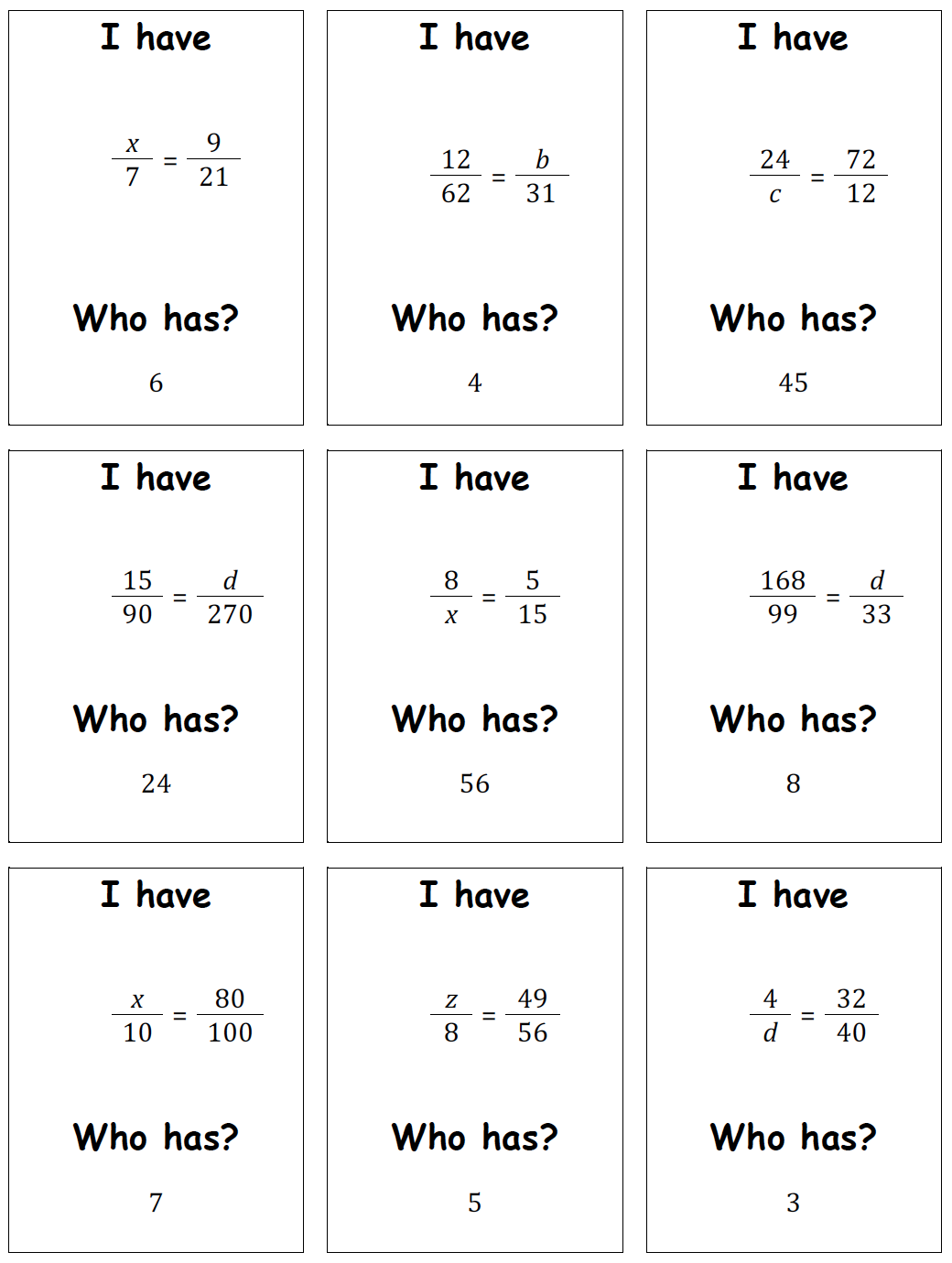
An I Have, Who Has game is not a new concept. The premiss is that each person gets a card that has two statements. One is the "I have" statement and the other is the "Who has" statement. In this case the "I have" statement is an proportion with a missing value and a "Who has" statement which is the answer. The way the game works is that a person starts by reading their "Who has" statement. For example, someone might say "Who has 24?". Someone else will have a card where their proportion has an answer that equals 24 so they would say " I have 8 over x equals 5 over 15". Who has 56?" That is, they read their proportion that has an answer that equals 24 and then asks their "Who has" statement. Then someone else will have an expression that matches 56 and the game continues. If done correctly, it should end up with the person who started giving their "I have" statement. It works really well as a warm up and one of nice things about this is that you could do it multiple days and kids will likely get different cards.

  • Gr8PA - solve and verify linear equations involving a one-variable term and having solutions that are integers, by using inspection, guess and check, and a “balance” model NOTE - only use the 9 card set if doing this for grade 8;
  • MPM1D - solve problems requiring the manipulation of expressions arising from applications of percent, ratio, rate, and proportion
  • MPM1D, MFM1P - solve first-degree equations, including equations with fractional coefficients, using a variety of tools (e.g., computer algebra systems, paper and pencil) and strategies (e.g., the balance analogy, algebraic strategies);
  • MFM1P - solve for the unknown value in a proportion, using a variety of methods
  • There are two sets of cards that you could download here. One set (pictured here) has only 9 cards in it (you can see that the card on the top left has the "I have" to match the "Who has" of the card on the bottom right). Depending on the size of class you have you might want to use this set multiple times (ie groups of 9) or use the larger set of 27. Either way, in order for the game to work, all cards need to be passed out. So some students may need to have more than one card.
  • Regardless. Print out the set you want (ideally on coloured card stock) and we also suggest lamination to lengthen the lifespan of the cards.
  • Be sure to print out a set for yourself that you don't cut out so that it will be easier for you to check as students play the game.
  1. Distribute the cards one per student. All cards must be handed out so some students might need more than one card.
  2. Tell each person to answer their "I have" proportion and check their answer with at least one other person. 
  3. Once students are confident with their answer all students should stand and then you choose one to read their "Who has" statement. The person who's answer is the same should read their "I have" statement followed by their "Who has" statement and then sit down. Eventually the last person standing should be the person who started. 
  4. A variation might be to have students walk to the front and stand next to the person who they were matched with and eventually form an entire loop around the class.
  • IHaveWhoHas-Proportions-9cards (pdf) (doc)
  • IHaveWhoHas-Proportions-27cards (pdf) (doc)
  • IHaveWhoHas-BlankTemplate (doc)
Did you use this activity? Do you have a way to make it better? If so tell us in the comment section. Thanks