Showing posts with label proportion. Show all posts

Saturday, 30 January 2016

Row Games

We saw this activity in 2010 when I first found @K8Nowak's blog f(t). I don't know if I would call a Row Game a particularly engaging activity but I am convinced that any way we can make doing boring homework questions more palatable for students is a good thing. The premiss is that you pair students up and they get a worksheet of questions. The questions are in two columns. Each person does one column and if they have done things correctly then their questions on the same row should have the same answer. If they don't then either one or both of them are incorrect and they have to work together to get the correct answer. So this is a self checking activity. We made a bunch of them at the time and I just stumbled upon them this week so we thought we would post them. These ones are for ratios, proportion, simplifying expressions and solving simple equations.

MFM1P, MPM1D
  • illustrate equivalent ratios, using a variety of tools
  • solve for the unknown value in a proportion, using a variety of methods 
  • make comparisons using unit rates
  • solve problems involving ratios, rates, and directly proportional relationships in various contexts, using a variety of methods
  • solve problems requiring the expression of percents, fractions, and decimals in their equivalent forms
  • add and subtract polynomials involving the same variable up to degree three, using a variety of tools
  • multiply a polynomial by a monomial involving the same variable to give results up to degree three
  • solve first-degree equations with non fractional (Applied only) coefficients, using a variety of tools and strategies
  •  Just the handouts (see below)
  1. Pair students up
  2. Have students decide who will be Student A or Student B, and have them complete Problem Set A or B.
  3. The answers in each row should match. If they do not match, work together to determine the correct answer.
  • See the files in one folder here
  • Proportions (Word, PDF)
  • Proportions Review (Word, PDF)
  • Simplifying Expressions (Word, PDF)
  • Adding Polynomials (Word, PDF)
  • Simplifying Expressions with Multiplication (Word, PDF)
  • Solving Equations (Word, PDF)
  • Solving Multistep Equations (Word, PDF)
Did you use this activity? Do you have a way to make it better? If so tell us in the comment section. Thanks

Monday, 14 December 2015

I Have, Who Has - Proportions

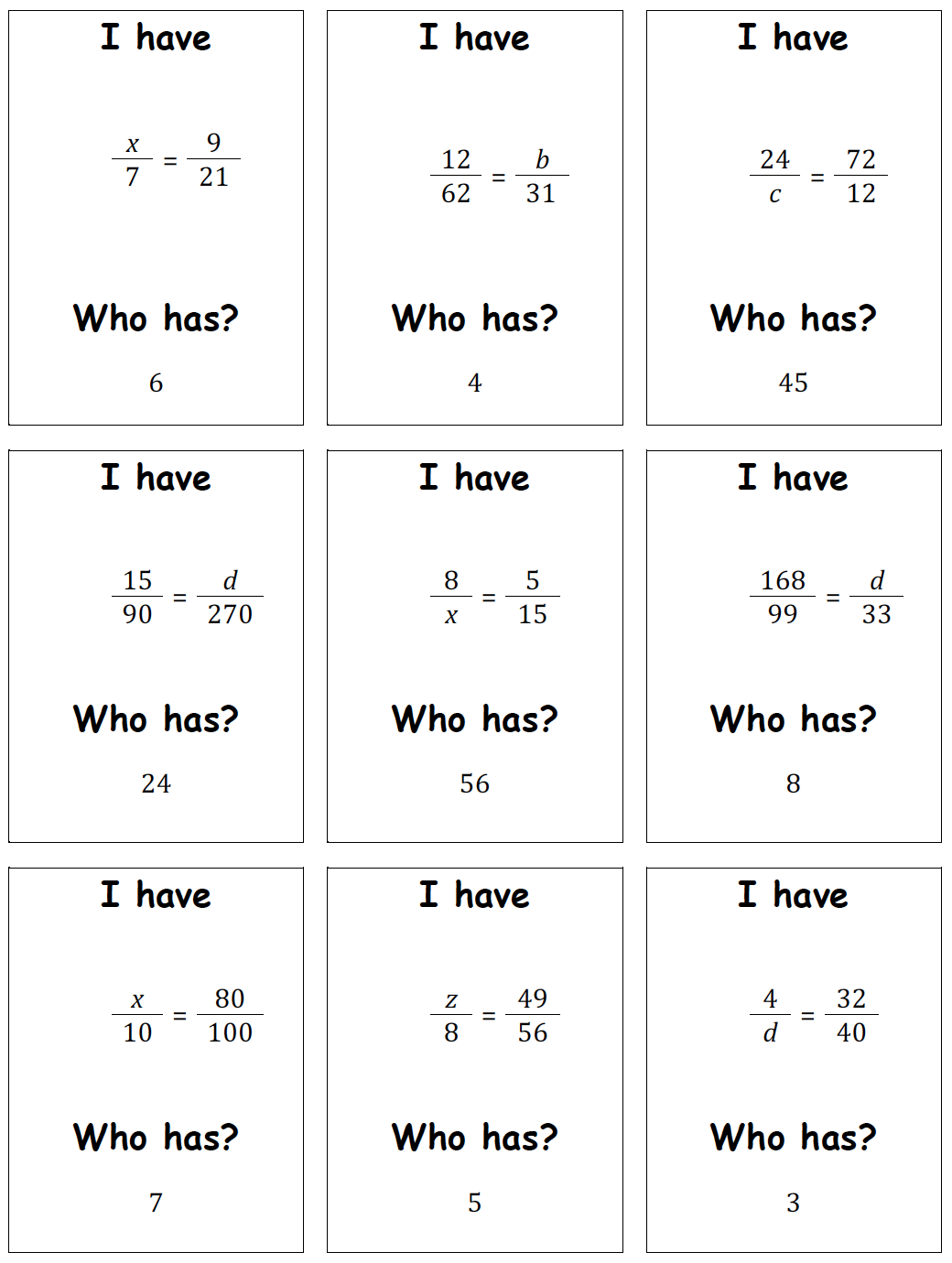
An I Have, Who Has game is not a new concept. The premiss is that each person gets a card that has two statements. One is the "I have" statement and the other is the "Who has" statement. In this case the "I have" statement is an proportion with a missing value and a "Who has" statement which is the answer. The way the game works is that a person starts by reading their "Who has" statement. For example, someone might say "Who has 24?". Someone else will have a card where their proportion has an answer that equals 24 so they would say " I have 8 over x equals 5 over 15". Who has 56?" That is, they read their proportion that has an answer that equals 24 and then asks their "Who has" statement. Then someone else will have an expression that matches 56 and the game continues. If done correctly, it should end up with the person who started giving their "I have" statement. It works really well as a warm up and one of nice things about this is that you could do it multiple days and kids will likely get different cards.

  • Gr8PA - solve and verify linear equations involving a one-variable term and having solutions that are integers, by using inspection, guess and check, and a “balance” model NOTE - only use the 9 card set if doing this for grade 8;
  • MPM1D - solve problems requiring the manipulation of expressions arising from applications of percent, ratio, rate, and proportion
  • MPM1D, MFM1P - solve first-degree equations, including equations with fractional coefficients, using a variety of tools (e.g., computer algebra systems, paper and pencil) and strategies (e.g., the balance analogy, algebraic strategies);
  • MFM1P - solve for the unknown value in a proportion, using a variety of methods
  • There are two sets of cards that you could download here. One set (pictured here) has only 9 cards in it (you can see that the card on the top left has the "I have" to match the "Who has" of the card on the bottom right). Depending on the size of class you have you might want to use this set multiple times (ie groups of 9) or use the larger set of 27. Either way, in order for the game to work, all cards need to be passed out. So some students may need to have more than one card.
  • Regardless. Print out the set you want (ideally on coloured card stock) and we also suggest lamination to lengthen the lifespan of the cards.
  • Be sure to print out a set for yourself that you don't cut out so that it will be easier for you to check as students play the game.
  1. Distribute the cards one per student. All cards must be handed out so some students might need more than one card.
  2. Tell each person to answer their "I have" proportion and check their answer with at least one other person. 
  3. Once students are confident with their answer all students should stand and then you choose one to read their "Who has" statement. The person who's answer is the same should read their "I have" statement followed by their "Who has" statement and then sit down. Eventually the last person standing should be the person who started. 
  4. A variation might be to have students walk to the front and stand next to the person who they were matched with and eventually form an entire loop around the class.
  • IHaveWhoHas-Proportions-9cards (pdf) (doc)
  • IHaveWhoHas-Proportions-27cards (pdf) (doc)
  • IHaveWhoHas-BlankTemplate (doc)
Did you use this activity? Do you have a way to make it better? If so tell us in the comment section. Thanks

Wednesday, 1 April 2015

Easter Proportional Reasoning Review Activity

This is an Easter review activity where students will answer proportional reasoning questions and collect eggs on the Smartboard.  (This is the Easter version to a previous Halloween activity post. If teaching in the spring this context makes more sense otherwise in the fall use the Halloween activity instead at this link - they are the same questions in both activities)


 MFM1P
  • illustrate equivalent ratios, using a variety of tools 
  • represent, using equivalent ratios and proportions, directly proportional relationships arising from realistic situations
  • solve for the unknown value in a proportion, using a variety of methods
  • make comparisons using unit rates – solve problems involving ratios, rates, and directly proportional relationships in various contexts using a variety of methods
  • solve problems requiring the expression of percents, fractions, and decimals in their equivalent forms

  • 51 plastic Easter eggs (find at a Dollar store)
  • 2 Easter baskets (find at a Dollar store)
  • proportional reasoning questions
  • solution handout
  • Smartboard
  • Smart Notebook file with score board
  • whiteboard and markers (optional)
  • Easter decorations (optional)
  • prizes for winning team (optional)


  1. Print questions in colour.  Cut out questions and place one in each of the 51 eggs.
  2. Place eggs in an Easter basket.
  3. Bring up the scoreboard on the smartboard.  (Could create your own scoreboard if a smartboard is not available)
  4. Place students is groups and give each student a whiteboard and marker.
  5. Have each group choose an Easter basket from the scoreboard.
  6. One student from the group will come up and choose an egg.  They will bring it back to their group where all members will answer the question inside.
  7. One person will then come and check their answer with the teacher.
  8. The teacher will check off that the group has answered that question.  
  9. The student will then drag an egg to their Easter basket on the smartboard.  Based on difficulty, questions with no eggs on the card students collect 1 egg and questions with  2  eggs on the card students collect 2 eggs.
  10. Have students place the question back in the egg and choose another one.  (Answered questions with egg should be put in a separate basket and put back in circulation when eggs get low.)
  11. The group who collects the most eggs will win.  


Note:  There are some special cards that students will find. I call these the golden eggs (they are not always in yellow eggs but the card is yellow).

The video, below, is only visible in the WECDSB domain. That is, only teachers in our school board can see the video if they are logged into their MyTools2Go accounts.


  • Proportional Reasoning Egg Hunt questions (pdf) (doc)
  • Proportional Reasoning Egg Hunt solutions (pdf) (doc)
  • Egg Hunt scoreboard (Smart Notebook file) (not)
Did you use this activity? Do you have a way to make it better? If so tell us in the comment section. Thanks

Thursday, 23 October 2014

Halloween Proportional Reasoning Review Activity

This is a Halloween review activity where students will answer proportional reasoning questions and collect candy on the Smartboard (This is the Halloween version to an Easter activity post. If teaching in the fall this context makes more sense otherwise in the spring use the Easter activity instead at this link - they are the same questions in both activities)

MFM1P 
  • illustrate equivalent ratios, using a variety of tools (e.g., concrete materials, diagrams, dynamic geometry software) 
  • represent, using equivalent ratios and proportions, directly proportional relationships arising from realistic situations
  • solve for the unknown value in a proportion, using a variety of methods
  • make comparisons using unit rates – solve problems involving ratios, rates, and directly proportional relationships in various contexts using a variety of methods
  • solve problems requiring the expression of percents, fractions, and decimals in their equivalent forms
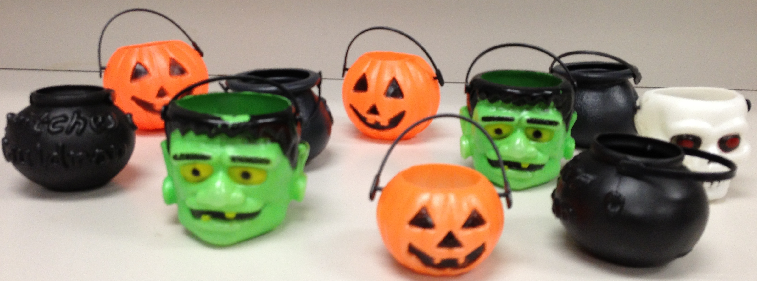
  • 49 Halloween containers (find at a Dollar store)
  • proportional reasoning questions
  • solution handout
  • Smartboard
  • Smart Notebook file with score board
  • whiteboard and markers (optional)
  • Halloween decorations (optional)
  • prizes for winning team (optional)

  1. Cut out questions and place one in each of the 49 containers.
  2. Spread out containers on a table and add some Halloween decorations (optional).
  3. Bring up the scoreboard on the smartboard.  (Could create your own scoreboard if a smartboard is not available)
  4. Place students is groups and give each student a whiteboard and marker.
  5. Have each group choose a Halloween bag from the scoreboard.
  6. One student from the group will come up and choose a container.  They will bring it back to their group where all members will answer the question inside.
  7. One person will then come and check their answer with the teacher.
  8. The teacher will check off that the group has answered that question.  
  9. The student will then drag a candy to their bag on the smartboard.  Questions with no pumpkins are worth 1 candy and questions with 2 pumpkins are worth 2 candies.
  10. Have students place the question back in the container and choose another one.  (Answered questions with container should be put to the side and put back in circulation when containers get low.)
  11. The group who collects the most candy will win.  
Note:  There are some special cards that students will find. Tap bags 1, 3, 6 or 8 on the Smartboard to play Halloween music.


The video, below, is only visible in the WECDSB domain. That is, only teachers in our school board can see the video if they are logged into their MyTools2Go accounts.

  • Proportional Reasoning Halloween questions (pdf) (doc)
  • Proportional Reasoning Halloween solutions (pdf) (doc)
  • Halloween scoreboard (Smart Notebook file) (not)
Did you use this activity? Do you have a way to make it better? If so tell us in the comment section. Thanks