Wednesday, 8 April 2015

Geometer's Sketchpad - Investigate Parallel Lines

When using the Geometer's Sketchpad it is often better to "start from sketch, not from scratch". That is, give students a premade sketch rather having them build something from nothing (as many textbooks would have you do).
In this activity, students investigate angle relationships in parallel lines cut by a transversal. The sketch has some dynamic investigation as well as embedded quizzes and ends with the definition of the theorems. So this sketch fits very well with the fact that the expectation for grade 8 is via investigation.


  • Gr8NS - determine, through investigation using a variety of tools (e.g., dynamic geometry software, concrete materials, protractor) and strategies (e.g., paper folding), the angle relationships for intersecting lines and for parallel lines and transversals, and the sum of the angles of a triangle;
  • MFM1P - determine, through investigation using a variety of tools (e.g., dynamic geometry software, concrete materials), and describe the properties and relationships of the angles formed by parallel lines cut by a transversal, and apply the results to problems involving parallel lines
  • MPM1D - As review
  • All that is needed is the electronic download (below)
  • Note that this really works well on an iPad using the Sketchpad Explorer App (which is free)
  • You can also use this on any web based computer (or Chromebook) with this Web sketch
Watch the video below to see how to use the sketch.


Did you use this activity? Do you have a way to make it better? If so tell us in the comment section. Thanks

Tuesday, 7 April 2015

Connecting Words and Algebraic Expressions

Students are given a set of cards that have either an algebraic expression or a word sentence. They then have to match up the expressions with the word sentences. This is not meant to be a big activity but just a quick one to help kids connect the different forms. You could use this in grade 7, 8 or 9.

NOTE: This activity has been updated and a newer version can be found here


  • Gr7 - translate phrases describing simple mathematical relationships into algebraic expressions, using concrete materials
  • Gr8 - translate statements describing mathematical relationships into algebraic expressions and equations
  • MPM1D, MFM1P - As review
  • There are four sets. Print each on a different colour card stock (there is no real reason for this except that if the cards get mixed up it is easier to get them back into their groups) and laminate (if possible) then cut them out.
  • Mix each set up and put each into an envelope
  • Because there are only four sets, you will have to make up multiple sets depending on how big your class is. 

  1. Put students into pairs or triads
  2. Give each group one set of cards
  3. Students are to match up the word sentence with the algebraic expression
  4. If time permits, have groups trade sets for a different colour.
  • Number Sentences (doc) (pdf)


Did you use this activity? Do you have a way to make it better? If so tell us in the comment section. Thanks

Thursday, 2 April 2015

Easter Analytic Geometry Review Activity


This is an Easter review activity where students will answer analytic geometry questions and collect eggs on the Smartboard. (This is the Easter version to a Halloween activity post. If teaching in the spring this context makes more sense otherwise in the fall use the Halloween activity instead at this link - they are the same questions in both activities)


MPM1D
  • determine, through investigation, the characteristics that distinguish the equation of a straight line from the equations of nonlinear relations
  • identify, through investigation, the equation of a line in any of the forms y = mx + b,             Ax + By + C = 0, x = a, y = b
  • express the equation of a line in the form y = mx + b, given the form Ax + By + C = 0
  • determine, through investigation, various formulas for the slope of a line segment or line and use the formulas to determine the slope of a line segment or a line
  • identify, through investigation with technology, the geometric significance of m and b in the equation y = mx + b
  • identify, through investigation, properties of the slopes of lines and line segments
  • graph lines by hand, using a variety of techniques
  • determine the equation of a line from information about the line
  • describe the meaning of the slope and y-intercept for a linear relation arising from a realistic situation
  • construct tables of values, graphs, and equations, using a variety of tools to represent linear relations derived from descriptions of realistic situations

  • 51 plastic Easter eggs (find at a Dollar store)
  • 2 Easter baskets (find at a Dollar store)
  • analytic geometry questions
  • solution handout
  • Smartboard
  • Smart Notebook file with score board
  • whiteboard and markers (optional)
  • Easter decorations (optional)
  • prizes for winning team (optional)

  1. Print questions in colour.  Cut out questions and place one in each of the 51 eggs.
  2. Place eggs in an Easter basket.
  3. Bring up the scoreboard on the smartboard.  (Could create your own scoreboard if a smartboard is not available)
  4. Place students is groups and give each student a whiteboard and marker.
  5. Have each group choose an Easter basket from the scoreboard.
  6. One student from the group will come up and choose an egg.  They will bring it back to their group where all members will answer the question inside.
  7. One person will then come and check their answer with the teacher.
  8. The teacher will check off that the group has answered that question.  
  9. The student will then drag an egg to their Easter basket on the smartboard.  Based on difficulty, questions with no eggs on the card students collect 1 egg, questions with  2  eggs on the card students collect 2 eggs and the same with 3 eggs.
  10. Have students place the question back in the egg and choose another one.  (Answered questions with egg should be put in a separate basket and put back in circulation when eggs get low.)
  11. The group who collects the most eggs will win.  
Note:  There are some special cards that students will find. I call these the golden eggs (they are not always in yellow eggs but the card is yellow).


To see the activity in action with an applied class (with proportional reasoning), go to this post (ie it runs the same way but with different questions) 

  • Analytic Geometry Egg Hunt questions (pdf) (doc)
  • Analytic Geometry Egg Hunt solutions (pdf) (doc)
  • Egg Hunt scoreboard (Smart Notebook file) (not)
Did you use this activity? Do you have a way to make it better? If so tell us in the comment section. Thanks

Halloween Analytic Geometry Review Activity

This is a Halloween review activity where students will answer analytic geometry questions and collect candy on the Smartboard.  (This is the Halloween version to an Easter activity post. If teaching in the fall this context makes more sense otherwise in the spring use the Easter activity instead at this link - they are the same questions in both activities)


 MPM1D
  • determine, through investigation, the characteristics that distinguish the equation of a straight line from the equations of nonlinear relations
  • identify, through investigation, the equation of a line in any of the forms y = mx + b,             Ax + By + C = 0, x = a, y = b
  • express the equation of a line in the form y = mx + b, given the form Ax + By + C = 0
  • determine, through investigation, various formulas for the slope of a line segment or line and use the formulas to determine the slope of a line segment or a line
  • identify, through investigation with technology, the geometric significance of m and b in the equation y = mx + b
  • identify, through investigation, properties of the slopes of lines and line segments
  • graph lines by hand, using a variety of techniques
  • determine the equation of a line from information about the line
  • describe the meaning of the slope and y-intercept for a linear relation arising from a realistic situation
  • construct tables of values, graphs, and equations, using a variety of tools to represent linear relations derived from descriptions of realistic situations

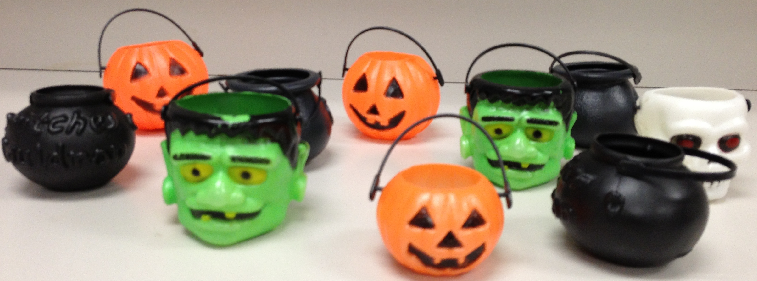
  • 49 Halloween containers (find at a Dollar store)
  • analytic geometry questions
  • solution handout
  • Smartboard
  • Smart Notebook file with score board
  • whiteboard and markers (optional)
  • Halloween decorations (optional)
  • prizes for winning team (optional)
  1. Cut out questions and place one in each of the 49 containers.
  2. Spread out containers on a table and add some Halloween decorations (optional).
  3. Bring up the scoreboard on the smartboard.  (Could create your own scoreboard if a smartboard is not available)
  4. Place students is groups and give each student a whiteboard and marker.
  5. Have each group choose a Halloween bag from the scoreboard.
  6. One student from the group will come up and choose a container.  They will bring it back to their group where all members will answer the question inside.
  7. One person will then come and check their answer with the teacher.
  8. The teacher will check off that the group has answered that question.  
  9. The student will then drag a candy to their bag on the smartboard.  Questions with no pumpkins are worth 1 candy, questions with 2 pumpkins are worth 2 candies and questions with 3 pumpkins are worth 3 candies.
  10. Have students place the question back in the container and choose another one.  (Answered questions with container should be put to the side and put back in circulation when containers get low.)
  11. The group who collects the most candy will win.  
 Note:  There are some special cards that students will find. Tap bags 1, 3, 6 or 8 on the Smartboard to play Halloween music.


To see the activity in action with an applied class (with proportional reasoning), go to this post (ie it runs the same way but with different questions) 

  • Analytic Geometry Halloween questions (pdf) (doc)
  • Analytic Geometry Halloween solutions (pdf) (doc)
  • Halloween scoreboard (Smart Notebook file) (not)
Did you use this activity? Do you have a way to make it better? If so tell us in the comment section. Thanks

Wednesday, 1 April 2015

Easter Proportional Reasoning Review Activity

This is an Easter review activity where students will answer proportional reasoning questions and collect eggs on the Smartboard.  (This is the Easter version to a previous Halloween activity post. If teaching in the spring this context makes more sense otherwise in the fall use the Halloween activity instead at this link - they are the same questions in both activities)


 MFM1P
  • illustrate equivalent ratios, using a variety of tools 
  • represent, using equivalent ratios and proportions, directly proportional relationships arising from realistic situations
  • solve for the unknown value in a proportion, using a variety of methods
  • make comparisons using unit rates – solve problems involving ratios, rates, and directly proportional relationships in various contexts using a variety of methods
  • solve problems requiring the expression of percents, fractions, and decimals in their equivalent forms

  • 51 plastic Easter eggs (find at a Dollar store)
  • 2 Easter baskets (find at a Dollar store)
  • proportional reasoning questions
  • solution handout
  • Smartboard
  • Smart Notebook file with score board
  • whiteboard and markers (optional)
  • Easter decorations (optional)
  • prizes for winning team (optional)


  1. Print questions in colour.  Cut out questions and place one in each of the 51 eggs.
  2. Place eggs in an Easter basket.
  3. Bring up the scoreboard on the smartboard.  (Could create your own scoreboard if a smartboard is not available)
  4. Place students is groups and give each student a whiteboard and marker.
  5. Have each group choose an Easter basket from the scoreboard.
  6. One student from the group will come up and choose an egg.  They will bring it back to their group where all members will answer the question inside.
  7. One person will then come and check their answer with the teacher.
  8. The teacher will check off that the group has answered that question.  
  9. The student will then drag an egg to their Easter basket on the smartboard.  Based on difficulty, questions with no eggs on the card students collect 1 egg and questions with  2  eggs on the card students collect 2 eggs.
  10. Have students place the question back in the egg and choose another one.  (Answered questions with egg should be put in a separate basket and put back in circulation when eggs get low.)
  11. The group who collects the most eggs will win.  


Note:  There are some special cards that students will find. I call these the golden eggs (they are not always in yellow eggs but the card is yellow).

The video, below, is only visible in the WECDSB domain. That is, only teachers in our school board can see the video if they are logged into their MyTools2Go accounts.


  • Proportional Reasoning Egg Hunt questions (pdf) (doc)
  • Proportional Reasoning Egg Hunt solutions (pdf) (doc)
  • Egg Hunt scoreboard (Smart Notebook file) (not)
Did you use this activity? Do you have a way to make it better? If so tell us in the comment section. Thanks

Thursday, 12 March 2015

Sort students into groups using Quadratic Representations

In this activity students are each given one card. The card will either have a graph, table of values or equation of a quadratic relation. Their job is to find the two other students who have the other two representations of the same quadratic relationship. This shouldn't take too long and could be repeated every couple of days to solidify conversion between representations.
New: Alternatively, you could have students just work individually on this Desmos card sort 


  • MPM2D - A3.3 determine, through investigation, and describe the connection between the factors of a quadratic expression and the x-intercepts (i.e., the zeros) of the graph of the corresponding quadratic relation, expressed in the form y = a(x – r)(x – s);
  • MBF3C - A1.8 determine, through investigation, and describe the connection between the factors of a quadratic expression and the x-intercepts of the graph of the corresponding quadratic relation
  • MCF3M - A1.5 determine, through investigation, and describe the connection between the factors used in solving a quadratic equation and the x-intercepts of the graph of the corresponding quadratic relation
  • MCR3U - As review
  • Download the cards and cut them out (you may want to laminate them)
  • If you are doing the Desmos Cardsort instead, students should have devices to do the sort on (note that phones have screens that are too small)
  1. Shuffle the cards and distribute one per student. Note that there are 11 sets of 3 cards so you may want to remove sets to more closely match your student population.
  2. Instruct students to find the two other people that have different representations for the same quadratic relation. 
  3. Once students find their partners they will be in groups of three
If doing the Desmos Cardsort instead, have students (or pairs of students) complete each page of the cardsort. You may wish to consolidate on the last page of the card sort.
Did you use this activity? Do you have a way to make it better? If so tell us in the comment section. Thanks